Python, APIs, and Code Assist
2026-01-20
Today’s goals
- Get comfortable with Python basics (for those coming from other languages)
- Understand what an API is and how to call one
- See how we interact with LLMs programmatically
- Learn to protect API keys
- Meet Gemini Code Assist
Python: if you know another language
Python will feel familiar. Key differences:
- Indentation matters — blocks are defined by whitespace, not braces
- Dynamic typing — no type declarations required (but type hints are optional)
- Everything is an object — functions, classes, modules
Python: variables and types
Type hints (optional but recommended):
Python: common patterns
Python: imports and modules
Packages are installed with pip:
What is an API?
API = Application Programming Interface
A way for programs to talk to each other using defined rules.
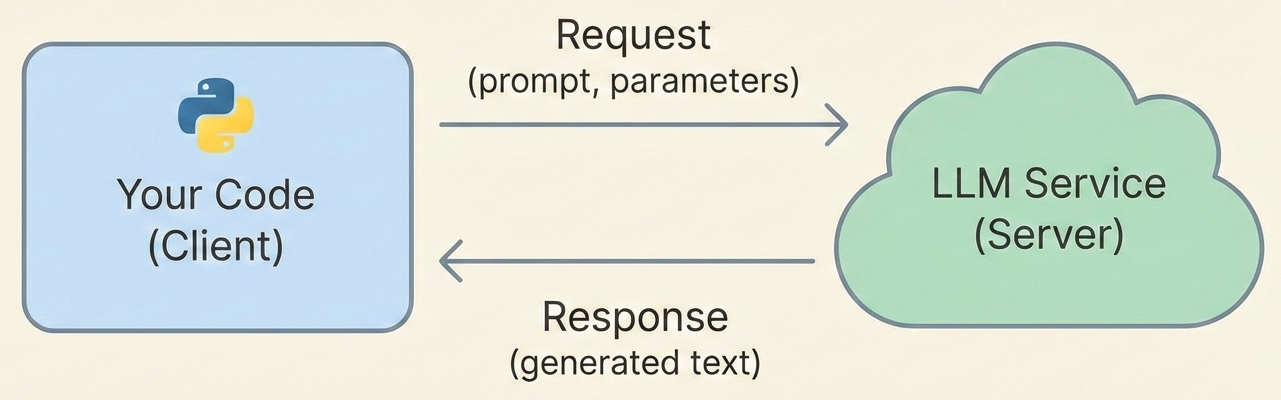
- Request: Your code sends data (prompt, settings)
- Response: The service sends back results (generated text)
Web APIs: the basics
Most modern APIs use HTTP:
Endpoint: A URL you send requests to
https://api.example.com/v1/generateMethod: Usually
POSTfor sending data,GETfor retrievingHeaders: Metadata including authentication
Authorization: Bearer sk-abc123...Body: The actual data (often JSON)
{"prompt": "Hello", "max_tokens": 100}
Calling an LLM via API
Instead of chatting in a browser, your code sends requests:
This is the raw Gemini SDK — useful to understand what’s underneath.
LangChain: model-agnostic abstractions
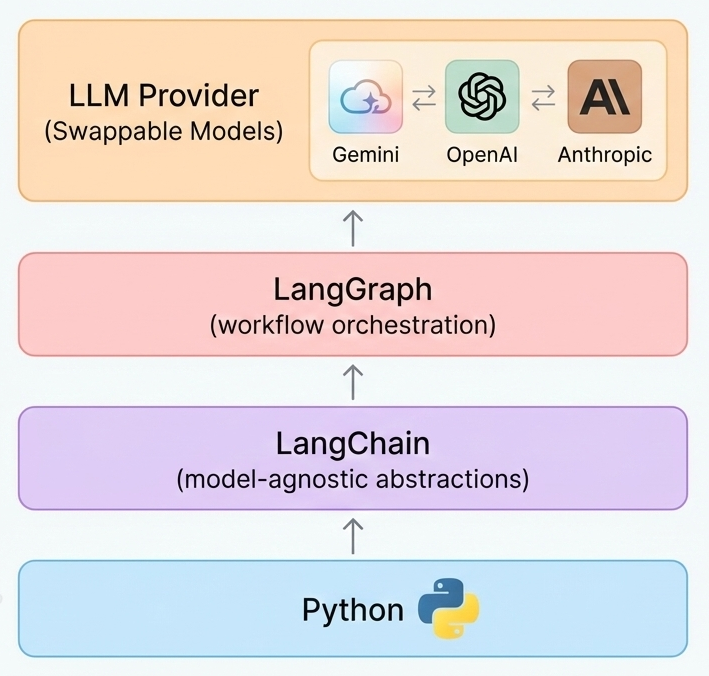
Going forward, we’ll use LangChain to write portable code:
Why? Swap one import to change providers (OpenAI, Anthropic, etc.).
Extracting text from responses
Gemini 3 models return structured content (for “thinking” features). Use this helper:
We’ll use get_text(response) instead of response.content throughout.
Our stack: Python + LangChain + LangGraph
LangGraph: state-based workflows
LangGraph uses a graph to define how your app flows:
from typing_extensions import TypedDict
from langgraph.graph import StateGraph, START, END

class State(TypedDict):
    prompt: str
    response: str

def respond(state: State) -> dict:
    # Call LLM here and return updated state
    return {"response": "Hello back!"}

graph = StateGraph(State)
graph.add_node("respond", respond)
graph.add_edge(START, "respond")
graph.add_edge("respond", END)

app = graph.compile()
result = app.invoke({"prompt": "Hello!", "response": ""})
API keys: what and why
An API key is like a password for your code:
- Identifies who is making requests
- Tracks usage for billing and rate limits
- Can be revoked if compromised
Your API key = your identity + your credit card
API key security: the rules
Never share your API key!
- Never commit keys to git — they become public forever
- Never paste keys in code — use environment variables
- Never share keys with classmates — each person needs their own
- Revoke immediately if exposed — generate a new one
Protecting keys: .env files
Store secrets in a .env file (never committed to git):
Load in Python:
Protecting keys: .gitignore
Your .gitignore file tells git what NOT to track:
Check your assignment repos — .env should already be in .gitignore
Before committing, verify with:
If you accidentally commit a key…
- Revoke the key immediately — generate a new one
- The old key is compromised forever (git history)
- Even if you delete the file, it’s still in history
- Automated bots scan GitHub for exposed keys
Prevention is much easier than cleanup!
Gemini Code Assist
An AI coding assistant built into VS Code:
- Code completion — suggests code as you type
- Chat interface — ask questions about your code
- Explain code — select code and ask for explanations
- Generate code — describe what you want in natural language
Code Assist: inline suggestions
As you type, Code Assist suggests completions:
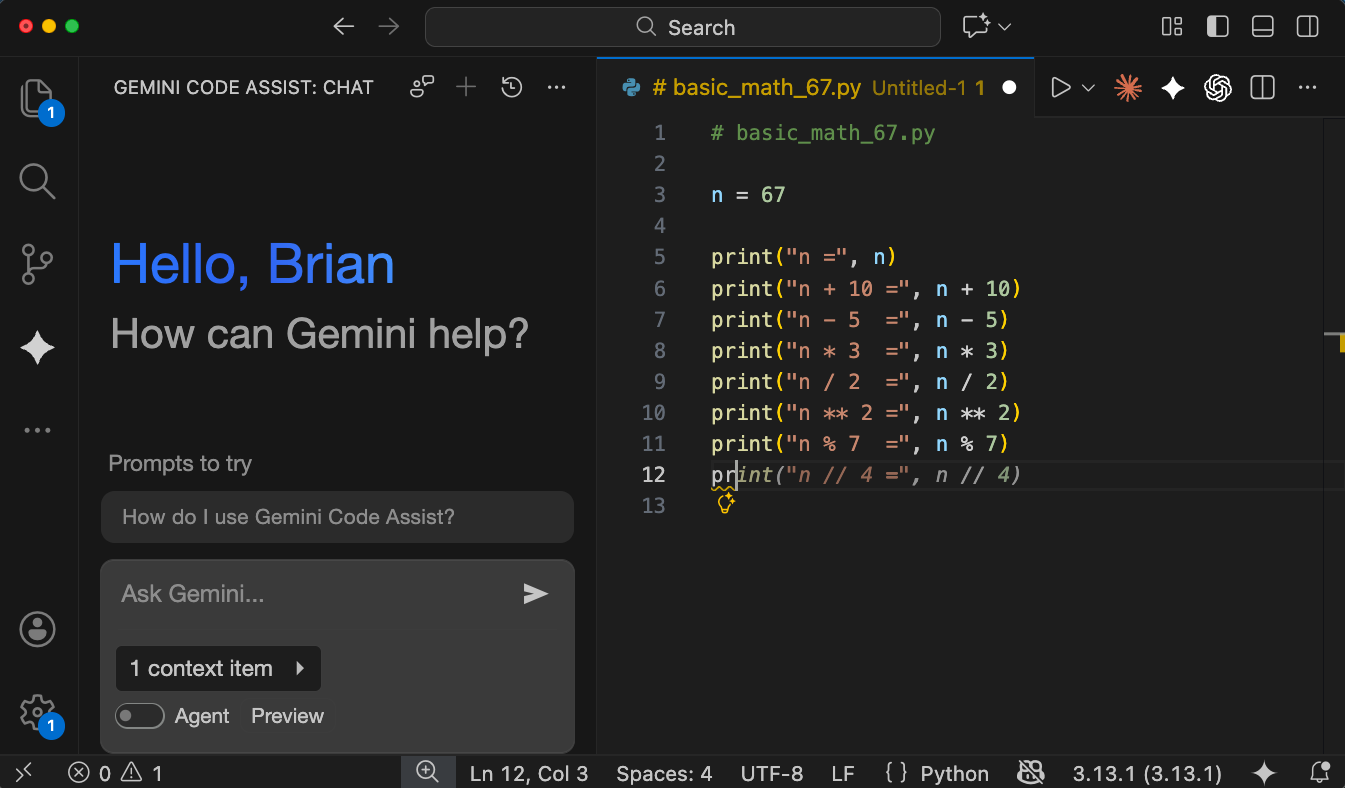
- Suggestions appear grayed out
- Press
Tabto accept - Keep typing to ignore
Code Assist: chat panel
Open the Gemini chat panel to ask questions:
- “How do I read a JSON file in Python?”
- “Explain what this function does” (with code selected)
- “Write a function that validates email addresses”
- “Why is this test failing?”
The chat understands your current file and workspace context.
Code Assist: effective use
Do:
- Use it to learn new syntax and patterns
- Ask it to explain unfamiliar code
- Let it handle boilerplate
- Verify suggestions before accepting
Don’t:
- Accept code you don’t understand
- Trust it blindly for logic/correctness
Code Assist + understanding
Remember the course philosophy:
- You are the developer — AI is your assistant
- You must understand all code you submit
- Code reviews will test your understanding
- Use AI to learn, not to bypass learning
Key takeaways
- Python: indentation matters, dynamic typing, everything is an object
- APIs let your code talk to services like Gemini
- Protect API keys: use
.envfiles, never commit secrets - Gemini Code Assist helps you code faster—but you stay in charge
Next steps
- Get your Gemini API key (see resources page)
- Install Gemini Code Assist in VS Code (see resources page)
- Start A2 using the GitHub Classroom Workflow
- Start experimenting with Code Assist as you work!