Custom States and Multi-Node Workflows
2026-02-27
Today’s goals
- Design custom
TypedDictstates for non-conversational workflows - Build multi-node graphs with specialized roles
- Route with conditional edges based on state values
- Use reducers to control how state updates are merged
- Wrap workflows with simple command-line interfaces
Recall: MessagesState
In decks 05-07, we used MessagesState for conversational apps:
MessagesState is a TypedDict with one field: messages (a list that accumulates).
When MessagesState works great
- Chat applications
- Tool-calling agents
- Retrieval Q&A
- Any workflow centered on conversation history
Pattern: user message → [tool calls if needed] → AI response
What if your app isn’t conversational?
Consider an arXiv paper analyzer:
- Fetch paper content from arXiv
- Extract metadata (title, authors, contributions)
- Look up publication info (tool: Semantic Scholar API)
- Generate summary with impact metrics and links
No chat history needed—just data flowing through processing stages.
Custom states for structured workflows
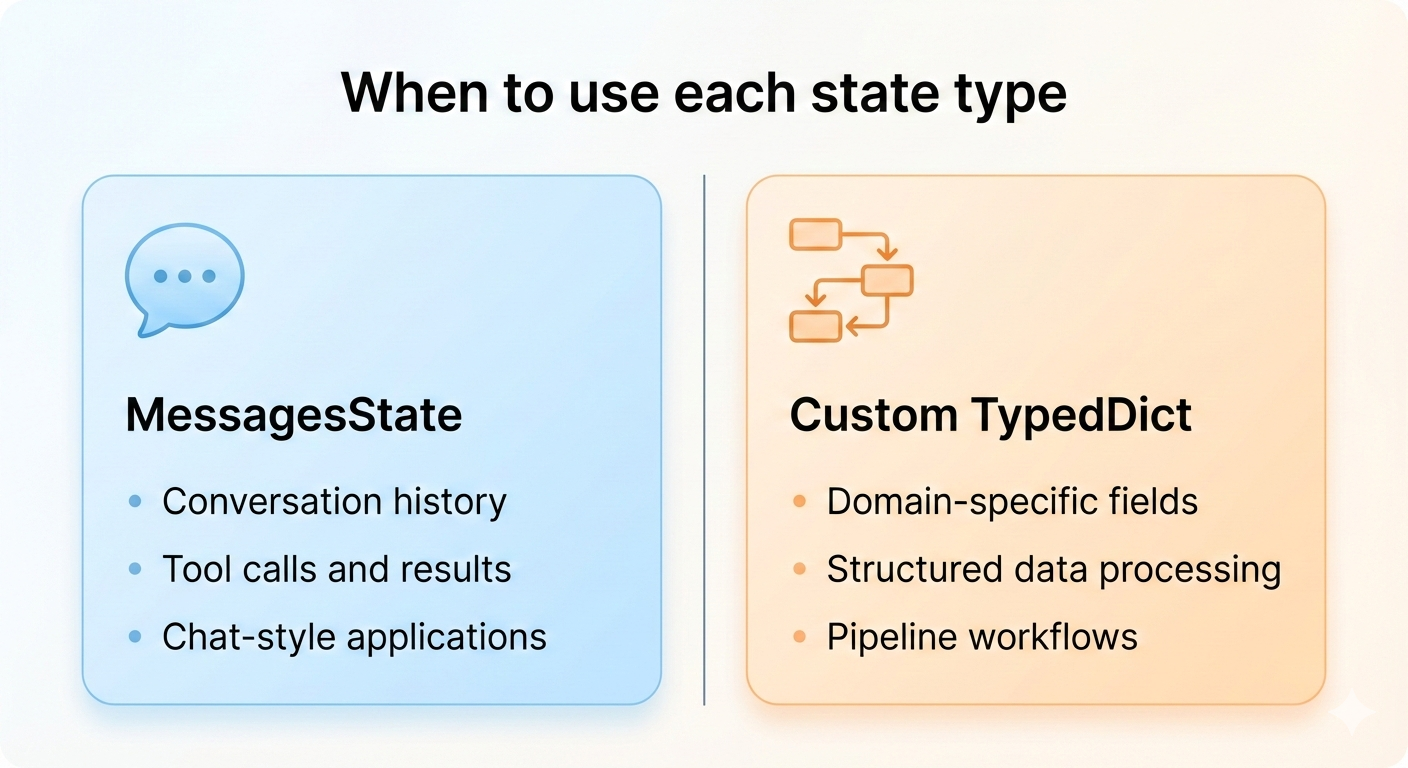
Choose the state structure that matches your data flow.
Part 1: arXiv Paper Analyzer
Example 1: Paper analyzer
Goal: Given an arXiv link, fetch the paper, look up its publication info, and generate a summary with impact metrics.
from typing_extensions import TypedDict

class PaperState(TypedDict):
    arxiv_url: str              # Input: arXiv link
    arxiv_id: str | None        # Extracted ID (e.g., "1706.03762")
    content: str | None         # Paper text
    metadata: dict | None       # title, authors, contributions
    impact: dict | None         # citations, venue, published DOI
    summary: str | None         # Final output
Each field serves a specific purpose in the pipeline.
The pipeline structure
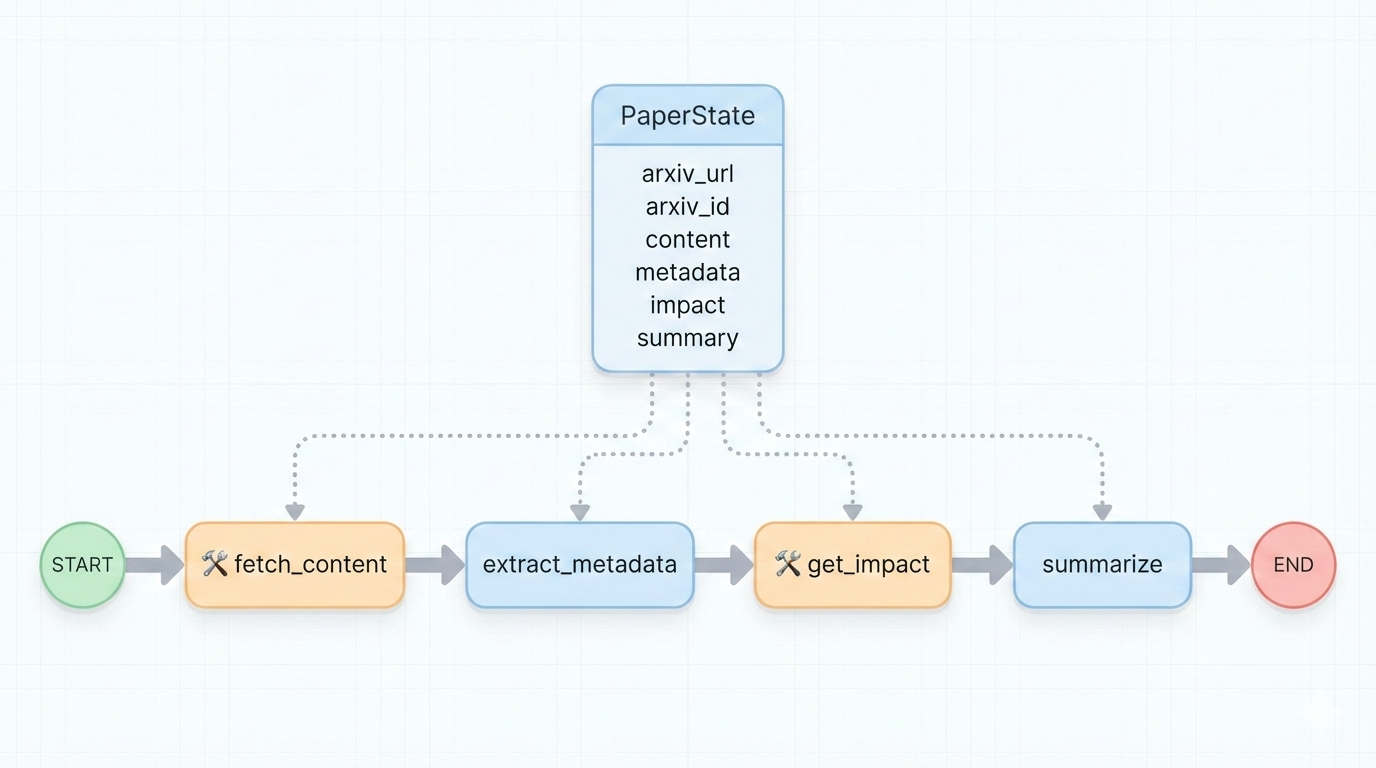
Four nodes: fetch (tool), extract, look up impact (tool), summarize.
Node 1: Fetch paper (tool)
import requests
import fitz  # PyMuPDF
from langchain.tools import tool

@tool
def fetch_arxiv_paper(arxiv_id: str) -> str:
    """Fetch an arXiv paper by its ID (e.g., '1706.03762') and extract text."""
    pdf_url = f"https://arxiv.org/pdf/{arxiv_id}.pdf"
    response = requests.get(pdf_url)

    if response.status_code != 200:
        return f"Error: HTTP {response.status_code}"

    # Load PDF and extract text
    doc = fitz.open(stream=response.content, filetype="pdf")
    text = "\n".join(page.get_text(sort=True) for page in doc)
    doc.close()

    return text
Uses PyMuPDF (pip install pymupdf) to extract text. Note: equations/complex layouts may not extract cleanly.
Node 1: Using the fetch tool
from langchain_google_genai import ChatGoogleGenerativeAI
from langchain.messages import HumanMessage, ToolMessage
import json

llm = ChatGoogleGenerativeAI(model="gemini-2.5-flash", temperature=0.1)

def fetch_content(state: PaperState) -> dict:
    """Let LLM parse URL and fetch paper content."""
    llm_with_tools = llm.bind_tools([fetch_arxiv_paper])
    messages = [HumanMessage(
        content=f"Extract the arXiv ID from this URL and fetch the paper: {state['arxiv_url']}"
    )]

    for attempt in range(3):  # Max 3 attempts
        response = llm_with_tools.invoke(messages)
        if not response.tool_calls:
            raise ValueError("LLM did not call the fetch tool")

        tool_call = response.tool_calls[0]
        arxiv_id = tool_call["args"]["arxiv_id"]

        try:
            result = fetch_arxiv_paper.invoke({"arxiv_id": arxiv_id})
        except Exception as e:
            result = f"Error: {e}"

        if result and not result.startswith("Error:"):
            return {"arxiv_id": arxiv_id, "content": result}

        # Tool failed—let LLM see error and retry
        messages.append(response)
        messages.append(ToolMessage(content=result or "No text extracted", tool_call_id=tool_call["id"]))

    raise ValueError(f"Failed to fetch paper after 3 attempts: {state['arxiv_url']}")
Why this pattern?
Why LLM-driven? URL formats vary. The LLM parses flexibly and retries on errors.
Why a manual loop instead of ToolNode/tools_condition?
- Data pipeline with custom state—not a conversational agent
- Only one node needs retries; the rest are simple
- Messages stay local, not in pipeline state
- Graph structure stays simple
Node 2: Extract metadata
from pydantic import BaseModel

class PaperMetadata(BaseModel):
    title: str
    authors: list[str]
    key_contributions: list[str] = []

def extract_metadata(state: PaperState) -> dict:
    """Use LLM to extract structured metadata from paper content."""
    structured_llm = llm.with_structured_output(PaperMetadata)

    prompt = f"""Extract metadata from this research paper.

Paper content:
{state['content']}"""

    metadata = structured_llm.invoke(prompt)
    return {"metadata": metadata.model_dump()}
with_structured_output() guarantees valid output matching the schema.
Node 3: Get paper impact (tool)
A second tool for external API lookup:
@tool
def get_paper_impact(arxiv_id: str) -> str:
    """Look up paper metadata and citations via Semantic Scholar."""
    url = f"https://api.semanticscholar.org/graph/v1/paper/arXiv:{arxiv_id}"
    params = {"fields": "title,authors,citationCount,venue,externalIds"}
    response = requests.get(url, params=params)

    if response.status_code == 200:  # HTTP 200 = success
        data = response.json()
        return json.dumps({
            "title": data.get("title"),
            "authors": [a["name"] for a in data.get("authors", [])],
            "citations": data.get("citationCount", 0),
            "venue": data.get("venue"),
            "doi": data.get("externalIds", {}).get("DOI")
        })
    return json.dumps({"error": "Paper not found"})
Node 3: Using the tool
def get_impact(state: PaperState) -> dict:
    """Look up publication info, overwrite metadata if available."""
    result = get_paper_impact.invoke({"arxiv_id": state["arxiv_id"]})
    data = json.loads(result)

    if "error" in data:  # Check for error key, not string in values
        return {"impact": {}}  # Keep Node 2's metadata

    # Overwrite title/authors with API data (more reliable), keep contributions
    updated = (state.get("metadata") or {}).copy()
    if data.get("title"):
        updated["title"] = data["title"]
    if data.get("authors"):
        updated["authors"] = data["authors"]

    return {
        "metadata": updated,
        "impact": {
            "citations": data.get("citations", 0),
            "venue": data.get("venue"),
            "doi": data.get("doi")
        }
    }
How state updates work
By default, returning a field replaces its value in state:
- Node 2 returns
{"metadata": {...}}→ setsmetadata - Node 3 returns
{"metadata": {...}}→ replacesmetadata
That’s why we do state.get("metadata").copy() then modify—if we just returned new metadata, we’d lose the key_contributions from Node 2.
Key insight: Only include a field in your return dict if you want to change it. If Node 3 returns {"impact": {}} without "metadata", the existing metadata is preserved.
Node 4: Summarize
def summarize(state: PaperState) -> dict:
    """Create a summary using all gathered information."""
    arxiv_link = f"https://arxiv.org/abs/{state['arxiv_id']}"
    doi = state.get("impact", {}).get("doi")
    doi_link = f"https://doi.org/{doi}" if doi else None

    prompt = f"""Summarize this research paper using the output format below.

<paper_content>
{state['content']}
</paper_content>

<metadata>
{state['metadata']}
</metadata>

<impact>
Citations: {state.get('impact', {}).get('citations', 'Unknown')}
Venue: {state.get('impact', {}).get('venue', 'Unknown')}
</impact>

<links>
arXiv: {arxiv_link}
DOI: {doi_link}
</links>

<output_format>
# [Paper Title]

**Authors:** [comma-separated list]

## Summary
[2-3 paragraph summary of the paper's main findings and methodology]

## Key Contributions
[bulleted list]

## Impact
**Citations:** [count] | **Venue:** [venue]

## Links
[markdown links to arXiv and DOI if available]
</output_format>"""

    response = llm.invoke([HumanMessage(content=prompt)])
    return {"summary": response.content}
Building the graph
from langgraph.graph import StateGraph, START, END

def build_paper_analyzer():
    graph = StateGraph(PaperState)

    # Add nodes
    graph.add_node("fetch_content", fetch_content)
    graph.add_node("extract_metadata", extract_metadata)
    graph.add_node("get_impact", get_impact)
    graph.add_node("summarize", summarize)

    # Connect in sequence
    graph.add_edge(START, "fetch_content")
    graph.add_edge("fetch_content", "extract_metadata")
    graph.add_edge("extract_metadata", "get_impact")
    graph.add_edge("get_impact", "summarize")
    graph.add_edge("summarize", END)

    return graph.compile()
Running the pipeline
No messages anywhere—just structured data flowing through.
Custom state patterns
Key principles:
- Include all fields your workflow needs
- Use typed fields (
str,dict,list,Nonefor optional) - Return partial updates from nodes (only changed fields)
- Initialize properly when invoking
Part 2: Conditional Routing
Beyond sequential: branching workflows
Sometimes the next step depends on what happened in previous steps.
Example: Content moderation
- Classify content as safe, questionable, or harmful
- Route to different handlers based on classification
Example 2: Content moderation
from typing import Literal
from pydantic import BaseModel

class ModerationState(TypedDict):
    content: str              # Input content to moderate
    classification: str | None # "safe", "questionable", or "harmful"
    result: str | None        # Final decision/action taken

class ContentClassification(BaseModel):
    classification: Literal["safe", "questionable", "harmful"]

# Using same llm from Example 1
def classify_content(state: ModerationState) -> dict:
    """Classify content into safety categories."""
    structured_llm = llm.with_structured_output(ContentClassification)

    prompt = f"""Classify this content:
- safe: appropriate for all audiences
- questionable: needs human review
- harmful: violates content policies

Content: {state['content']}"""

    result = structured_llm.invoke(prompt)
    return {"classification": result.classification}
The routing function
def route_content(state: ModerationState) -> Literal["publish", "human_review", "reject"]:
    """Route based on classification result."""
    classification = state["classification"]

    if classification == "safe":
        return "publish"
    elif classification == "questionable":
        return "human_review"
    else:  # harmful
        return "reject"
The Literal return type documents the possible destinations clearly.
The moderation workflow
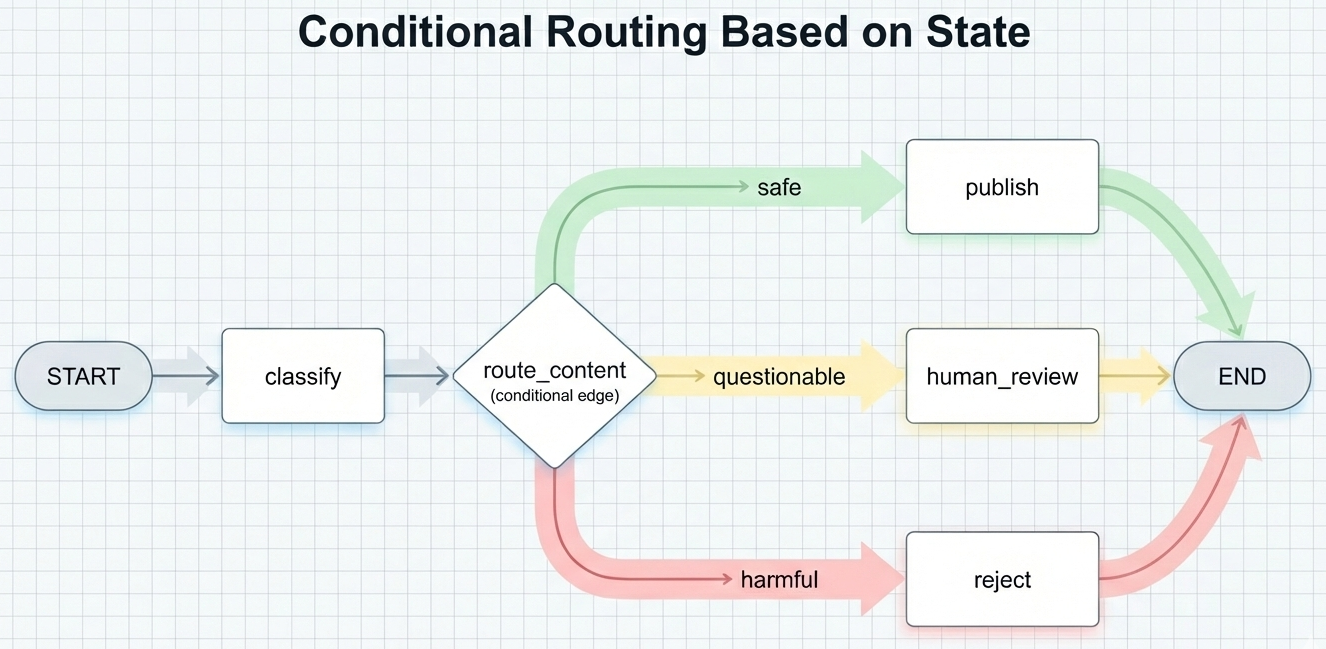
Different paths for different classifications.
Handler nodes
def publish(state: ModerationState) -> dict:
    """Approve and publish the content."""
    return {"result": "Content approved and published."}

def human_review(state: ModerationState) -> dict:
    """Flag for human review."""
    return {"result": "Content flagged for human review."}

def reject(state: ModerationState) -> dict:
    """Reject harmful content."""
    return {"result": "Content rejected due to policy violation."}
Each handler returns the appropriate result.
Building the moderation graph
def build_moderation_workflow():
    graph = StateGraph(ModerationState)

    graph.add_node("classify", classify_content)
    graph.add_node("publish", publish)
    graph.add_node("human_review", human_review)
    graph.add_node("reject", reject)

    graph.add_edge(START, "classify")

    # Conditional routing after classification
    graph.add_conditional_edges("classify", route_content)

    # All handlers lead to END
    graph.add_edge("publish", END)
    graph.add_edge("human_review", END)
    graph.add_edge("reject", END)

    return graph.compile()
Visualizing the graph
LangGraph uses the Literal return type from route_content to discover all possible paths—that’s how it knows to show edges to publish, human_review, and reject.
Visualization output
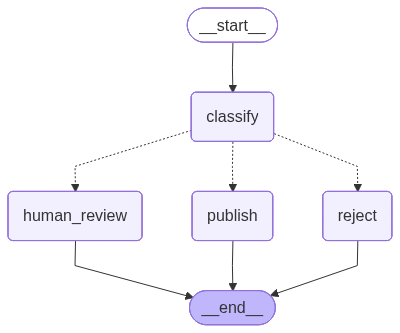
Dotted lines indicate conditional edges—the path taken depends on the routing function’s return value.
Running the moderation workflow
Part 3: Reducers
The problem: multiple nodes updating the same field
What if multiple nodes need to add to the same field?
Example: Multiple reviewers each provide feedback
Without special handling, the second reviewer overwrites the first!
Example 3: Multi-reviewer workflow
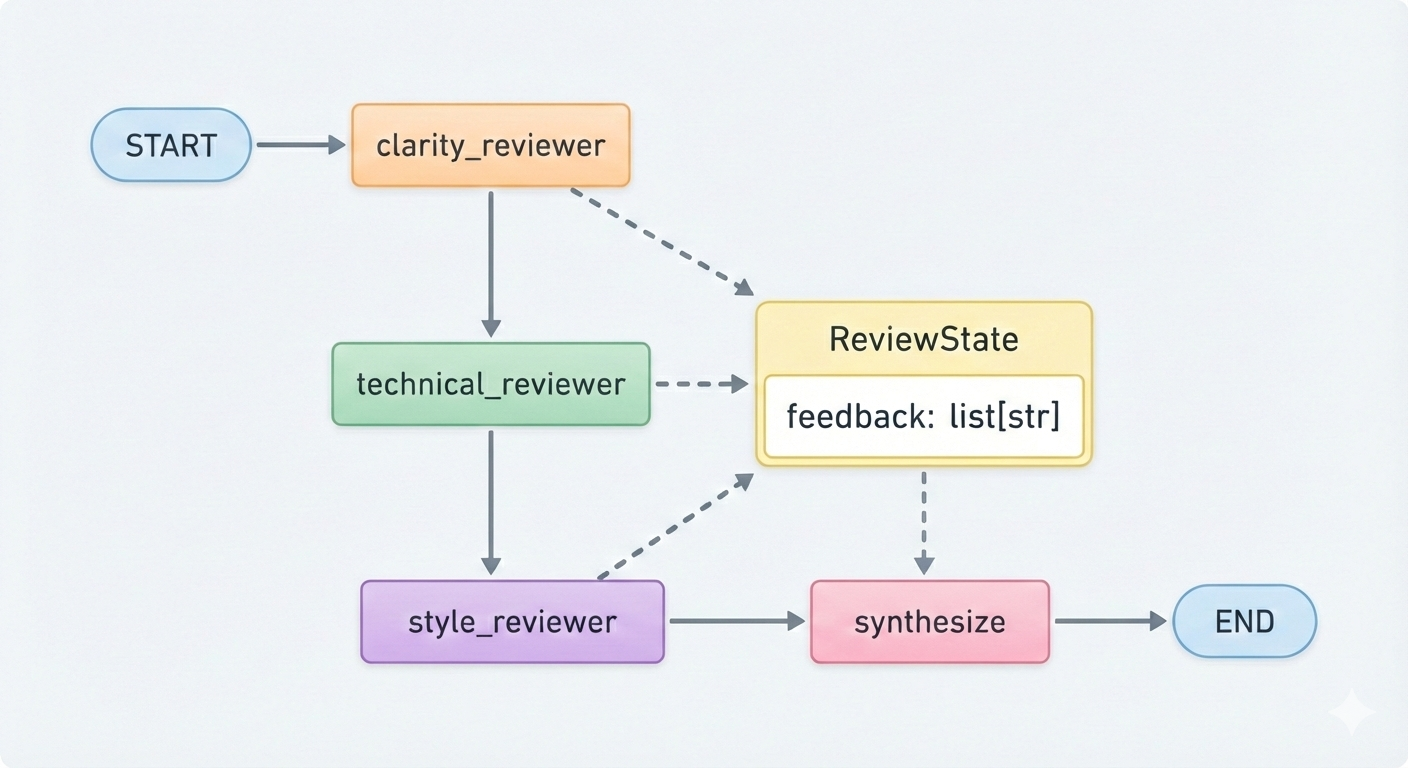
We want all feedback to accumulate, not overwrite.
Reducers control state merging
A reducer defines how updates are combined with existing state.
Here operator.add is the reducer—a function that takes (old, new) and returns the merged result.
What this tells LangGraph
Annotated[list[str], operator.add] means:
- The field type is
list[str] - When a node returns
{"feedback": [...]}, calloperator.add(existing, new) - Result: lists are concatenated, not replaced
Without a reducer: each update replaces the field. With operator.add: updates accumulate.
Clarity and technical reviewers
# Using same llm setup as before
def clarity_reviewer(state: ReviewState) -> dict:
    """Review for clarity and readability."""
    prompt = f"""Review this document for clarity.
Provide 1-2 sentences of feedback.

Document: {state['document']}"""

    response = llm.invoke([HumanMessage(content=prompt)])
    return {"feedback": [f"Clarity: {response.content}"]}

def technical_reviewer(state: ReviewState) -> dict:
    """Review for technical accuracy."""
    prompt = f"""Review this document for technical accuracy.
Provide 1-2 sentences of feedback.

Document: {state['document']}"""

    response = llm.invoke([HumanMessage(content=prompt)])
    return {"feedback": [f"Technical: {response.content}"]}
Style reviewer and synthesis
def style_reviewer(state: ReviewState) -> dict:
    """Review for writing style."""
    prompt = f"""Review this document for writing style.
Provide 1-2 sentences of feedback.

Document: {state['document']}"""

    response = llm.invoke([HumanMessage(content=prompt)])
    return {"feedback": [f"Style: {response.content}"]}

def synthesize(state: ReviewState) -> dict:
    """Combine all reviewer feedback into a summary."""
    all_feedback = "\n".join(state["feedback"])
    prompt = f"""Synthesize this feedback into actionable recommendations:

{all_feedback}"""

    response = llm.invoke([HumanMessage(content=prompt)])
    return {"final_summary": response.content}
Building the review workflow
def build_review_workflow():
    graph = StateGraph(ReviewState)

    graph.add_node("clarity", clarity_reviewer)
    graph.add_node("technical", technical_reviewer)
    graph.add_node("style", style_reviewer)
    graph.add_node("synthesize", synthesize)

    graph.add_edge(START, "clarity")
    graph.add_edge("clarity", "technical")
    graph.add_edge("technical", "style")
    graph.add_edge("style", "synthesize")
    graph.add_edge("synthesize", END)

    return graph.compile()
Running the review workflow
app = build_review_workflow()

result = app.invoke({
    "document": """This paper presents a novel approach to...""",
    "feedback": [],  # Start with empty list
    "final_summary": None
})

print("All feedback collected:")
for item in result["feedback"]:
    print(f"  - {item}")

print(f"\nSynthesis:\n{result['final_summary']}")
All three reviewers’ feedback is collected automatically!
You’ve already been using a reducer
MessagesState uses add_messages as its reducer:
That’s why messages accumulate instead of being replaced.
Common reducer patterns
| Pattern | Use case |
|---|---|
Annotated[list, operator.add] |
Collecting items from multiple nodes |
Annotated[list, add_messages] |
Chat message history |
| Custom function | Keeping max, merging dicts, etc. |
Custom reducer example
Keep the highest confidence score (e.g., spam detection):
Now multiple analyzers can update confidence and the highest wins.
Part 4: Command-Line Interfaces
Why a CLI?
You’ve been using CLIs like python -m ai_in_loop.cli chat. Now let’s see how to build one:
- Clear interface — users see available options with
--help - Input validation — catches errors before running the workflow
- Easy to automate — call from scripts, cron jobs, other programs
Anatomy of a CLI command
- Arguments: required inputs, positional (order matters)
- Options: optional settings, named with
--or- - Flags: options that are on/off (no value needed)
Typer: CLIs from type hints
Typer turns Python functions into CLI commands:
Function parameters become CLI arguments. Docstring becomes help text.
Arguments vs options in Typer
- No default → required argument
- Has default → optional argument
But what about --output style options?
Adding options with typer.Option
typer.Option converts a parameter into a --name style option.
How it looks to the user
$ python analyze.py "https://arxiv.org/abs/1706.03762" -o summary.txt
Summary written to summary.txt

$ python analyze.py --help
Usage: analyze.py [OPTIONS] ARXIV_URL

  Analyze an arXiv paper and generate a summary.

Arguments:
  ARXIV_URL  [required]

Options:
  -o, --output TEXT  Output file
  --help             Show this message and exit.
Wrapping a LangGraph workflow
import typer

def analyze(
    arxiv_url: str,
    output: str | None = typer.Option(None, "--output", "-o", help="Output file")
):
    """Analyze an arXiv paper and generate a summary."""
    # Run the LangGraph workflow from Example 1
    pipeline = build_paper_analyzer()
    result = pipeline.invoke({
        "arxiv_url": arxiv_url,
        "arxiv_id": None, "content": None,
        "metadata": None, "impact": None, "summary": None
    })

    if output:
        with open(output, "w") as f:
            f.write(result["summary"])
        print(f"Summary written to {output}")
    else:
        print(result["summary"])

if __name__ == "__main__":
    typer.run(analyze)
Using the CLI
Typer handles argument parsing, validation, and generates --help automatically.
Boolean flags
Use bool with a False default to create on/off flags:
Key takeaways
- Custom
TypedDictstates for non-conversational workflows - Nodes return partial updates—LangGraph merges them
- Conditional edges route based on state values
- Reducers control how updates merge (accumulate vs replace)
- Typer wraps workflows as command-line tools
When to use what
| Scenario | Approach |
|---|---|
| Chat or Q&A | MessagesState |
| Structured pipeline | Custom TypedDict |
| Sequential steps | add_edge() |
| Branching logic | add_conditional_edges() |
| Accumulating data | Annotated[list, operator.add] |
Resources
- LangGraph Graph API — StateGraph, edges, and conditional routing
- LangGraph Reference: Graphs — State and reducer functions
- Typer Documentation